In preparation for my pancreas transplant, one of the many tests I needed to undergo to assure my body would be able to withstand the surgery and recovery, was a cardiac catheterization.
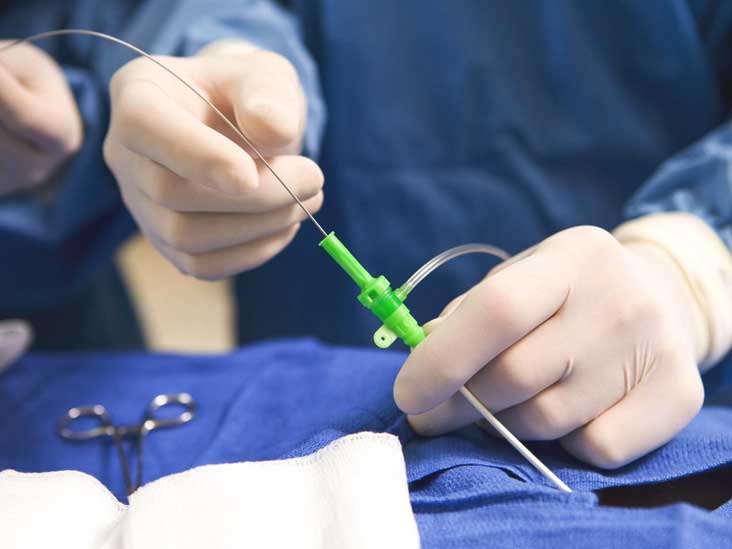
The purpose of this test is to examine how well the heart is functioning by inserting a tube into the heart through an artery, in my case the radial artery in my right wrist.
The advantage of accessing an artery through my wrist versus through an artery in my groin was that the recovery time is significantly shorter. If the groin access is used, recovery requires laying flat for at least six hours to assure the bleeding has stopped. As sitting still for any period of time is extremely challenging for me and the chances of needing to stay over night at the hospital increased with the groin access, I was all too eager for the wrist route to be successful.
The exam was to take place off island due to Kaiser could not perform the test on Hawaii Island. Travel was arranged for myself and a companion because even though I would not be driving home (rather, I’d be shuttling to and from the facility from the airport), they would not release me from the hospital with out a companion.
I like to be in control, I do not like being doped up if I can help it. So when the nurse reported to me that the procedure was not too painful because there are no nerves in the arteries, I was reassured that I had made the right choice refusing anesthesia.
I felt it all. And it hurt.
I was laying flat on my back with arm extended at my side, unable to see what the surgeon was doing. As a nurse, I have assisted in surgeries where catheters were inserted through the groin. I had helped to feed or remove the long wires and tubes in and out of patient’s bodies, so I had a very good idea what was happening. Lidocaine was injected into my wrist at the entry point. The lidocaine burned but only temporarily. Next the tube was inserted (I assume, I was not informed of the play by play). This required some manipulation apparently as I continued to feel the tugging and aching pressure for some time until the doctor exclaimed, “got it.”
Then it got interesting. It turns out my heart has an anomaly. The entrance point for my heart is unusually far off to the left making it extremely difficult to access. If you are a heart specialist cringing as you read this, I apologize for my ignorance. At the time this was explained to me, I was too full of relief to grasp the description of my heart anomaly as well as I’d like. The doctor attempted inserting multiple catheters of different styles trying to access the difficult site.
With the first catheter inserted, I felt aching pressure up my forearm, to my bicep then into my chest. As it was pulled out and another inserted, I felt it more distinctly. By the third, tears began to spring from my eyes as the aching pressure became a painful vibration as if a screw was being pulled through a narrow straw.
The doctor decided on one last attempt using a device he did not usually work with. As he pulled the device (I assume was the guide wire although I cannot be certain), the grating I felt was so incredibly painful, when the doctor asked if I was OK, it took me a solid 30 seconds before I could compose myself enough to answer. I gasped, ‘yep’. He recommended I take a dose of fentanyl because the muscle spasms I was experiencing may be causing a problem. I allowed for the smallest possible dose but did not feel the slightest difference.
While the pain was intensifying, I was praying. I prayed with all my heart for the wrist access to be successful. I begged God please, please let this work. At last, the doctor again exclaimed, “got it!” To which the nurse shouted “alright!” I smiled through the tears and called out, ‘woo-hoo!’ I was genuinely grateful.
The recovery for the procedure required I wait at the hospital for three more hours, laying in bed, to be sure there would be no bleeding from the access site. A small clear plastic cuff, about the size of a Fitbit was applied to my wrist. Air was pumped into the cuff placing intense pressure to the puncture. After an hour of wearing the cuff, my thumb became numb and my hand ached as if there were limited blood flow to the area. Upon alerting the nurse, the air was slowly removed over the next hour and a clear dressing was applied. I waited another hour and enjoyed a fantastic cup of coffee and an omelet. The coffee and food was meh, but I was hangry and inpatient; it was all I needed to relax a bit.
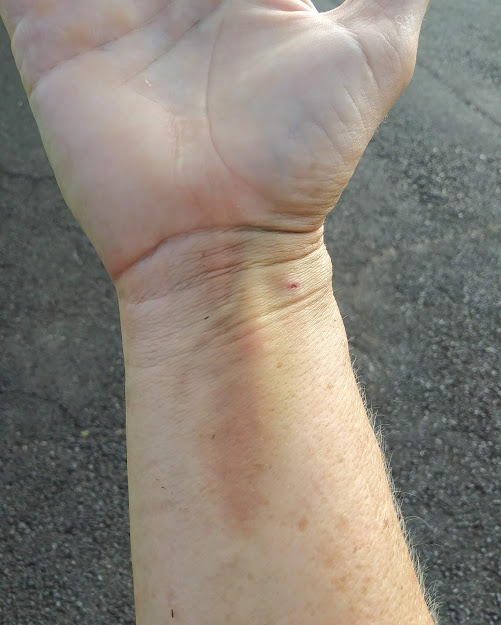
My right arm was sore for about four days. The bruising (pictured) did not really show up until day three and four. Given the fact that I love my body for all that it has done for me, I decided to follow the doctor’s advise and take it easy. Although I resumed light cardio the day after the procedure, I waited until today, day four, to grip light weights for weight lifting, and I felt pretty good.
The best news of all; my heart is great. After the procedure, the doctor remarked “I cannot believe this is the heart of a diabetic, you must have taken really good care of your diabetes.” The blood vessels were healthy with no signs of narrowing. I was so overwhelmed with gratitude that all was well and the procedure was over, that I could not tell him that in fact, no, my diabetes has always been a struggle.
Thank you God for my perfect heart.
 Joyful Chaos